HW Interview

SI-01 · English original · KO · ZH-TW · VI

走线什么时候算传输线?

什么时候必须把 PCB 走线当作传输线处理?

免费完整答案

先想一想。 先别往下看:起决定作用的是时钟频率,还是别的?把反射的往返时间和边沿上升时间放在一起想。
查看答案
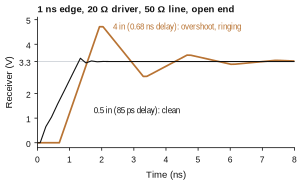
Receiver voltage versus time for a 0.5 inch and a 4 inch open-ended 50 ohm line driven by a 20 ohm driver with a 1 ns edge; the short line settles cleanly at 3.3 V, the long line overshoots to about 4.7 V and rings.
Same 1 ns edge: a 0.5 in trace (85 ps delay) is clean, a 4 in trace (0.68 ns) overshoots to 4.7 V and rings (3.3 V, 20 Ω driver). The length compared with the rise time decides.
Animation: an edge leaves the driver, takes the line delay td to reach the open end, reflects, and returns to the driver after 2·td. driver rcvr 4 in of 50 Ω trace · td ≈ 0.68 ns edge travels down the line open end reflects it (Γ = +1): back after 2·td If 2·td is longer than the edge, you see the bounce as ringing.
The edge needs td to reach the far end and 2·td to come back; when that is comparable with the 1 ns rise time, the reflection shows up as overshoot and ringing.

先这样回答: 作为初步估计,当走线延时超过 10–90% 上升时间的约 1/5–1/6 时。真正的界限取决于叠层延时和你能接受的失真。FR4 延时约 150–180 ps/in,所以 1 ns 的边沿下超过 ~1 英寸的都是传输线,100 ps 的边沿下超过 ~0.1 英寸的都是。看的是边沿,不是时钟频率:边沿为 1 ns 的 1 MHz 时钟,在长于约 1 英寸的走线上照样振铃。把它当传输线,并按拓扑选择端接。

要记住的数字: FR4 中 v = c/√Dk ≈ 6 in/ns;Len_max[in] ≈ RT[ns];BW ≈ 0.35/RT。

面试官想听到的:
  • 决定因素是上升时间,不是时钟频率
  • 一个带数字的长度门限(约为上升时间对应长度的 1/6)
  • 怎么处理:做端接,或者把走线做短
常见错误。 用时钟频率来回答。一个边沿为 1 ns 的 1 MHz 时钟,在长于约 1 英寸的走线上照样振铃;先由边沿决定,再由拓扑决定端接。

下一道免费题: 反射与反射系数 →

书里还有更多

本题是 Hardware Engineer Interview Questions(英文版)中的 SI-01。全书 141 道题都按同样方式作答:先说什么、怎样解释、要记住的数字,以及接下来的追问。

关于本书Sample PDF