HW Interview

SI-01 · English original · KO · ZH · VI

走線什麼時候算傳輸線?

什麼時候必須把 PCB 走線當作傳輸線處理?

免費完整答案

先想一想。 先別往下看:起決定作用的是時脈頻率,還是別的?把反射的往返時間和邊沿上升時間放在一起想。
查看答案
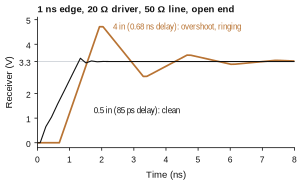
Receiver voltage versus time for a 0.5 inch and a 4 inch open-ended 50 ohm line driven by a 20 ohm driver with a 1 ns edge; the short line settles cleanly at 3.3 V, the long line overshoots to about 4.7 V and rings.
Same 1 ns edge: a 0.5 in trace (85 ps delay) is clean, a 4 in trace (0.68 ns) overshoots to 4.7 V and rings (3.3 V, 20 Ω driver). The length compared with the rise time decides.
Animation: an edge leaves the driver, takes the line delay td to reach the open end, reflects, and returns to the driver after 2·td. driver rcvr 4 in of 50 Ω trace · td ≈ 0.68 ns edge travels down the line open end reflects it (Γ = +1): back after 2·td If 2·td is longer than the edge, you see the bounce as ringing.
The edge needs td to reach the far end and 2·td to come back; when that is comparable with the 1 ns rise time, the reflection shows up as overshoot and ringing.

先這樣回答: 作為初步估計,當走線延時超過 10–90% 上升時間的約 1/5–1/6 時。真正的界限取決於疊層延時和你能接受的失真。FR4 延時約 150–180 ps/in,所以 1 ns 的邊沿下超過 ~1 英寸的都是傳輸線,100 ps 的邊沿下超過 ~0.1 英寸的都是。看的是邊沿,不是時脈頻率:邊沿為 1 ns 的 1 MHz 時鐘,在長於約 1 英寸的走線上照樣振鈴。把它當傳輸線,並按拓撲選擇端接。

要記住的數字: FR4 中 v = c/√Dk ≈ 6 in/ns;Len_max[in] ≈ RT[ns];BW ≈ 0.35/RT。

面試官想聽到的:
  • 決定因素是上升時間,不是時脈頻率
  • 一個帶數字的長度門限(約為上升時間對應長度的 1/6)
  • 怎麼處理:做端接,或者把走線做短
常見錯誤。 用時脈頻率來回答。一個邊沿為 1 ns 的 1 MHz 時鐘,在長於約 1 英寸的走線上照樣振鈴;先由邊沿決定,再由拓撲決定端接。

下一道免費題: 反射與反射係數 →

書裡還有更多

本題是 Hardware Engineer Interview Questions(英文版)中的 SI-01。全書 141 道題都按同樣方式作答:先說什麼、怎樣解釋、要記住的數字,以及接下來的追問。

關於本書Sample PDF