
Interview questions by topic
Capacitor types, ferrite beads, diodes and MOSFETs as real parts.
Op-amp rules, noise, TIAs, real-part limits.
Anti-aliasing, driving an ADC, noise in numbers.
Buck and boost, inductors, loops, protection.
Decoupling, target impedance, ground bounce, input protection.
Transmission lines, reflections, crosstalk, loss.
SerDes, PCIe, MIPI, USB and DDR at the PHY level.
I²C, SPI, resets, power-on to main().
Return paths, shielding, ESD and emissions.
Stack-ups, routing, HDI, design for yield.
Scopes, probing, bring-up and root cause.
Open design problems, from power tree to product.
Your own stories: failure, conflict, ownership.
Eight topics readers were asked in their own interviews.
12 questions with free full answers
See all 149 questionsEach free answer shows the full working and the mistake most people make.
- When is a trace a transmission line?SI-01
- How a buck converter worksPW-01
- Sizing I²C pull-upsEM-02
- How many decoupling caps?PI-01
- The three op-amp rulesAN-01
- Analog/digital partitioningPCB-03
- Choosing the inductorPW-04
- Reflections and the reflection coefficientSI-02
- I²C vs SPIEM-01
- Ground bouncePI-02
- Inverting gain of −10, non-idealAN-02
- Stack-up for a mixed-signal boardPCB-01
I²C pull-up calculator
Enter supply, bus speed and capacitance. Get the resistor window and the standard values inside it.
967 Ω – 1.77 kΩ
Also free: Is my trace a transmission line?, buck inductor, PDN target impedance, op-amp noise and 13 more calculators.
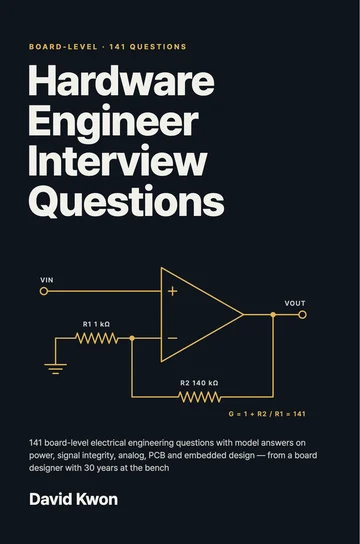
The book
149 board-level questions. Each question is on the front of a page. Turn it over for the answer: what to say first, why it is true, and often a story from the bench. Worked numbers live here, one page per question.
A free 2-week study plan
Ten study days by track: general board, power, signal integrity, embedded or senior system. Printable, no sign-up. Open the study plan